AI Agents for Exporting Romanian Businesses
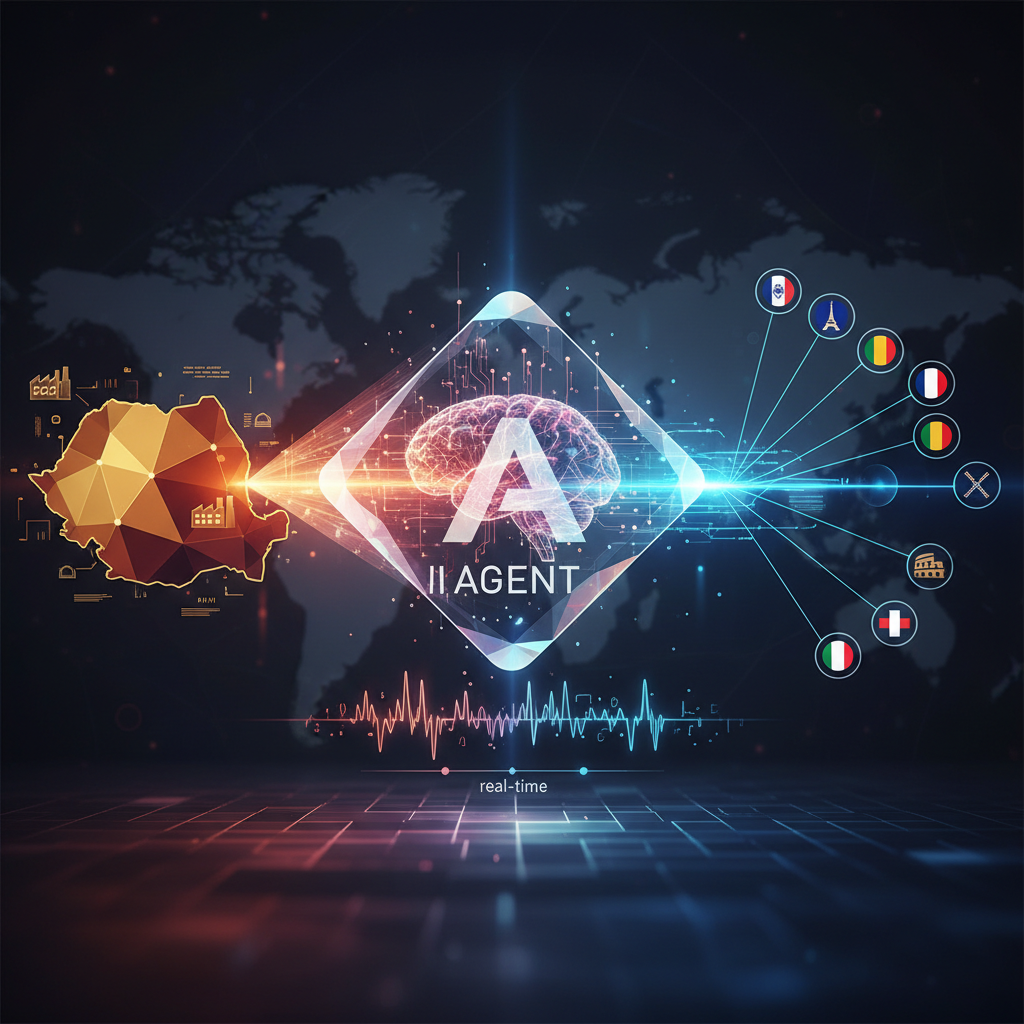
An AI agent is a software program capable of perceiving its environment, making decisions, and taking actions to achieve specific goals. In the context of international trade, AI agents specifically focus on automating and optimizing tasks like translation and cultural adaptation of commercial offers.
What is an AI agent, and how does it translate commercial offers?
An AI agent is an autonomous entity that observes its environment through sensors and acts upon that environment through effectors. For commercial offers, an AI agent integrates natural language processing (NLP) and machine learning (ML) to process source texts. It then translates these texts into target languages while analyzing linguistic nuances and cultural contexts.
This process involves more than mere word-for-word translation. The agent identifies idiomatic expressions, business jargon, and cultural sensitivities to ensure the translated offer is not only grammatically correct but also culturally appropriate and persuasive for the intended audience. For example, a direct translation of a marketing slogan might lose its impact or even convey an unintended meaning in another culture.
How does AI ensure cultural adaptation in real-time for EU markets?
Cultural adaptation for EU markets with AI agents goes beyond basic translation to encompass deep understanding of regional customs, business etiquette, and consumer preferences. Real-time adaptation means that as commercial offers are generated or updated, the AI system instantly adjusts content to resonate with the specific cultural background of each EU country.
This is achieved through extensive training data, which includes localized market intelligence, historical sales data, and cultural guidelines for various European regions. The AI analyzes factors like communication style (e.g., direct vs. indirect), preferred marketing appeals (e.g., value vs. prestige), and even visual elements. For Romanian companies exporting to Germany, for instance, an AI agent might suggest a more fact-based and direct communication style, while for Italy, it might lean towards emphasizing design and passion.
What are the main benefits of using AI agents for commercial outreach?
Implementing AI agents for commercial outreach offers several significant benefits for Romanian businesses looking to expand into the EU.
Firstly, it dramatically accelerates the time-to-market. Manual translation and localization processes can take weeks, delaying entry into new markets. AI agents can perform these tasks in minutes, allowing companies to respond to opportunities rapidly.
Secondly, AI agents ensure consistency and quality across all international communications. By leveraging standardized algorithms and cultural datasets, they reduce the risk of human error and ensure that brand messaging remains coherent, regardless of the target language.
Finally, these agents lead to substantial cost savings. Businesses can reduce expenses related to hiring multiple human translators and cultural consultants, redirecting these resources to other growth initiatives. The efficiency gained also optimizes sales cycles.
What challenges might Romanian firms face when adopting AI agents?
While highly beneficial, adopting AI agents for commercial adaptation presents certain challenges.
- Data Quality and Availability: AI models are only as good as the data they are trained on. Romanian firms need access to high-quality, culturally relevant datasets for each target EU market. Poor data can lead to inaccurate translations or inappropriate cultural adaptations.
- Integration Complexity: Integrating AI agent systems with existing CRM, ERP, and sales platforms can be complex. It requires robust APIs and potentially custom development to ensure seamless workflow and data exchange.
- Maintenance and Updates: AI models require continuous monitoring, updating, and fine-tuning to remain effective. Market dynamics, language evolution, and cultural shifts necessitate ongoing adjustments to the agent's knowledge base.
- Initial Investment: The initial investment in AI technology, including software licenses, infrastructure, and expert consultation, can be substantial for some SMEs.
How much does an AI agent solution for translation and cultural adaptation cost?
The cost of an AI agent solution for real-time translation and cultural adaptation for EU markets can vary widely based on several factors. These include the scope of features, the number of target languages, the level of customization required, and integration complexity with existing systems.
Basic, off-the-shelf AI translation tools might range from a few hundred to a few thousand euros annually in subscription fees. However, a comprehensive AI agent solution, custom-built or significantly configured to handle real-time cultural adaptation of commercial offers for multiple EU countries, typically starts from €15,000 for smaller deployments and can go upwards of €100,000 for complex enterprise-level integrations. Projects requiring extensive data training and highly specialized linguistic and cultural nuances might even exceed this, potentially reaching €250,000. The total cost often depends on whether a company opts for a SaaS model or a proprietary, in-house system.
What is the implementation timeline for such AI agents?
The timeline for implementing an AI agent solution for real-time translation and cultural adaptation typically spans from 3 to 12 months.
- Discovery and Requirements Gathering (1-2 months): This initial phase involves understanding the client's specific needs, target markets, existing systems, and the types of commercial offers to be processed. It also includes defining linguistic and cultural parameters.
- System Design and Data Preparation (1-3 months): During this stage, the AI architecture is designed, and relevant linguistic and cultural data are collected, cleaned, and prepared for training the AI models. This often involves sourcing localized content and cultural guidelines.
- Development and Customization (2-4 months): This is where the AI agent is built or customized. It includes developing translation engines, cultural adaptation algorithms, and integration modules for CRM/ERP systems. For example, a Romanian company might need specific integration with a German CRM.
- Testing and Refinement (1-2 months): Rigorous testing is conducted with real commercial offers in various target languages and cultural contexts to ensure accuracy, fluency, and cultural appropriateness. Feedback loops are crucial here for iterative improvements.
- Deployment and Training (1 month): The AI agent is deployed into the production environment. User training and ongoing support are provided to ensure smooth adoption and maximum utilization.
Who benefits from AI agents for real-time cultural adaptation?
AI agents for real-time cultural adaptation are most beneficial for Romanian businesses that frequently engage with diverse EU markets. This includes Small and Medium-sized Enterprises (SMEs) looking to scale their international sales operations without incurring extensive manual localization costs. Companies in industries such as IT services, manufacturing, e-commerce, and professional services, which regularly generate proposals, marketing campaigns, or product descriptions for export, find these tools invaluable.
Specifically, businesses aiming to penetrate at least three or more distinct EU markets simultaneously or those dealing with a high volume of commercial offers (e.g., over 50 unique proposals per month) will see the most significant return on investment. The technology helps maintain competitive advantage by ensuring rapid, accurate, and culturally resonant communication, which is crucial in fast-paced European markets. Start4AI, an AI development company based in Cluj-Napoca, Romania, specializes in building custom AI agent solutions that empower businesses to achieve these efficiencies in their international endeavors. You can learn more at https://start4ai.ro.
Who this is NOT for
This solution is not primarily for businesses with very infrequent international communications or those targeting a single, very specific, niche market where highly specialized human translators with deep domain expertise might still be more cost-effective for minimal volume. It is also less suited for companies whose core business involves highly creative, subjective content where AI cannot replicate human ingenuity or emotional depth, such as literary translations or highly artistic marketing campaigns requiring nuanced poetic license. Firms unwilling to invest in initial setup and data infrastructure might also find it unsuitable.
Frequently asked questions
What is an AI agent for commercial offers?
An AI agent for commercial offers is a sophisticated software system that leverages artificial intelligence to automate and optimize the translation and cultural adaptation of business proposals, marketing materials, and other commercial communications for international markets. It ensures messages resonate effectively with diverse audiences.
How do AI agents improve market entry for Romanian exporters?
AI agents enhance market entry by enabling real-time, culturally nuanced communication. This eliminates language barriers and cultural misunderstandings, allowing Romanian businesses to present their commercial offers accurately and appealingly to potential clients across various EU countries, accelerating deal cycles and reducing operational costs.
What are the typical costs associated with implementing AI agents?
The cost of implementing AI agents for real-time translation and cultural adaptation typically ranges from €15,000 to €100,000 or more, depending on the complexity, integration needs, and scale of deployment. Smaller, off-the-shelf solutions are on the lower end, while custom, enterprise-level integrations are significantly higher.
How long does it take to implement an AI agent system?
Implementing an AI agent system for commercial offer adaptation can take between 3 to 12 months. This timeline includes requirements gathering, custom development, integration with existing CRM/ERP systems, extensive testing, and deployment. The duration varies based on customization and system complexity.
Which types of businesses benefit most from AI agents for export?
Businesses that benefit most are those with frequent and high-volume commercial interactions across multiple EU countries, particularly SMEs looking to scale internationally quickly. Companies in sectors like manufacturing, IT services, and e-commerce with diverse product portfolios and target markets see significant returns.