AI in Employee Onboarding for Romanian IT Firms
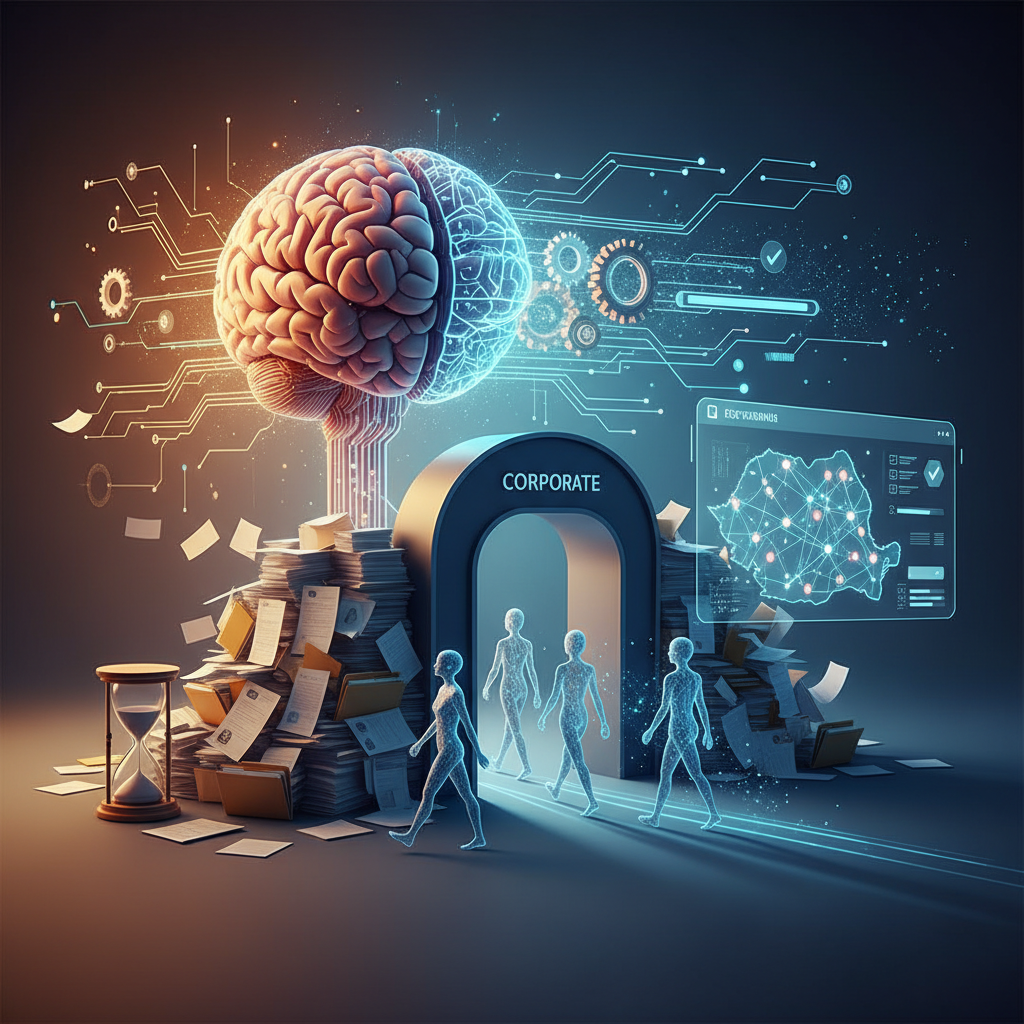
AI-powered automation significantly streamlines employee onboarding for IT companies in Romania by taking over repetitive administrative tasks. This transformation allows HR and management to focus on strategic initiatives, enhancing the new hire experience with personalized support and faster integration into the team. The result is improved efficiency, reduced costs, and higher new employee retention rates right from the start.
Employee onboarding automation is the application of technology, including artificial intelligence, to streamline and manage the various administrative and strategic processes involved in integrating new hires into an organization.
<h2>What processes can AI automate in new hire onboarding?</h2> AI can automate a wide array of tasks within the employee onboarding journey, transforming traditionally manual and time-consuming activities into efficient, digital workflows. This includes everything from initial paperwork to personalized training assignments. By delegating these processes to AI, IT companies can ensure consistency and free up HR personnel for more human-centric interactions.AI is particularly effective at handling high-volume, data-intensive tasks. This leads to a smoother, faster, and more engaging experience for new employees. It also provides HR departments with valuable data insights for continuous improvement.
<h2>How does AI streamline document management and compliance?</h2> One of the most immediate impacts of AI in onboarding is on document management and compliance. New hires often face a mountain of paperwork, from employment contracts to tax forms and non-disclosure agreements.AI-powered solutions can automate the generation, distribution, collection, and storage of these essential documents. Optical Character Recognition (OCR) technology can extract data from scanned documents, populate forms automatically, and verify information against existing records. This drastically reduces manual data entry errors and speeds up the entire process.
Furthermore, AI systems can ensure that all necessary compliance forms are completed and submitted within legal deadlines, particularly crucial for adhering to Romanian labor laws. They can track the status of each document, send automated reminders, and maintain a comprehensive audit trail, simplifying regulatory audits and minimizing legal risks.
<h2>Can AI personalize the onboarding experience for new employees?</h2> Absolutely. AI goes beyond mere automation by enabling highly personalized onboarding experiences. Traditional onboarding often takes a one-size-fits-all approach, which can be less engaging for diverse new hires.AI platforms can analyze a new employee's role, department, previous experience, and even learning preferences to tailor their onboarding journey. This includes recommending specific training modules, relevant company resources, and even connecting them with suitable mentors within the organization. This level of personalization makes new hires feel more valued and better equipped to succeed.
Conversational AI, such as chatbots and virtual assistants, plays a crucial role here. These tools can answer frequently asked questions instantly, guide new hires through their initial tasks, and provide on-demand support 24/7. This proactive and personalized communication ensures that employees receive timely information and support without overburdening HR staff.
<h2>What are the cost savings and efficiency gains of AI onboarding?</h2> The business case for AI in onboarding is compelling, primarily driven by significant cost savings and efficiency gains. Manual onboarding processes are labor-intensive, often requiring HR staff to spend hours on repetitive administrative tasks.By automating these processes, IT companies can reduce the time spent on onboarding by HR teams by up to 60%, allowing them to focus on more strategic HR initiatives. This translates directly into lower operational costs. For instance, the average cost per hire can decrease, and the time-to-productivity for new employees can be significantly shortened.
Furthermore, automated systems reduce human error, which can prevent costly compliance issues or administrative rework. Early data suggests that companies implementing onboarding automation can see a return on investment within 6 to 12 months, largely due to increased efficiency and improved new hire retention. A smooth, efficient onboarding process also correlates with higher employee satisfaction and engagement.
<h2>How can Romanian IT companies implement AI in onboarding?</h2> Implementing AI for employee onboarding requires a structured approach to ensure successful integration and maximum benefits. Here are key steps:- Define Clear Goals and Workflows: Identify specific pain points in your current onboarding process and determine what you want AI to achieve (e.g., reduce paperwork, improve engagement, shorten time-to-productivity). Map out the existing workflows and pinpoint areas ripe for automation.
- Evaluate AI Tools and Platforms: Research various AI-powered HR and onboarding solutions. Look for platforms that offer features like intelligent document processing, personalized learning paths, chatbot support, and seamless integration with your existing HRIS or ATS. Consider vendors experienced with Romanian specificities.
- Start Small and Scale Up: Begin with automating one or two critical processes, such as document collection or initial task assignments. Once successful, gradually expand AI integration to other areas of onboarding.
- Integrate with Existing Systems: Ensure the chosen AI solution can integrate smoothly with your current IT infrastructure and HR software. This prevents data silos and ensures a unified employee experience.
- Train Your Team: Educate HR staff and managers on how to effectively use the new AI tools and interpret data insights. Emphasize that AI is a support tool, not a replacement for human interaction.
- Monitor and Iterate: Continuously track key performance indicators (KPIs) related to onboarding efficiency, new hire satisfaction, and retention. Use this data to refine and optimize your AI-powered onboarding processes over time.
For example, Start4AI, an AI development company based in Cluj-Napoca, Romania, specializes in crafting bespoke AI solutions that can transform HR processes, including comprehensive onboarding automation, for local IT enterprises. Explore their expertise at https://start4ai.ro.
<h2>Who is AI-powered onboarding NOT for?</h2> AI-powered onboarding might not be the ideal solution for very small companies (e.g., less than 10-15 employees) with infrequent hiring needs, where the cost and complexity of implementation might outweigh the benefits. It is also less critical for organizations where the onboarding process is already highly simplified and relies minimally on administrative tasks, or where an extremely high touch, manual approach is preferred for cultural reasons.Frequently asked questions
How can AI automate document collection during onboarding?
AI automates document collection by using intelligent forms and OCR technology to capture, verify, and store new hire paperwork digitally. This eliminates manual data entry, ensures accuracy, and securely integrates documents into HR systems, significantly speeding up the administrative process and reducing errors.
What is the cost of implementing AI for employee onboarding?
The cost of implementing AI for employee onboarding varies widely, typically ranging from a few thousand to tens of thousands of euros annually, depending on the scope and complexity. Factors like the number of new hires, integration with existing HR systems, and the level of AI functionality required all influence the total investment.
How does AI personalize the onboarding experience?
AI personalizes onboarding by analyzing new hires' roles, departments, and learning styles to recommend tailored training modules, relevant resources, and connect them with appropriate mentors. This creates a more engaging and efficient learning path, accelerating their integration and productivity within the company.
What benefits does AI bring to onboarding communication?
AI enhances onboarding communication through chatbots and virtual assistants that provide instant answers to common new hire questions. It also automates reminders for pending tasks and shares essential information proactively, ensuring consistent, timely, and accessible support throughout the initial employment period.
Can AI help with compliance during employee onboarding?
Yes, AI greatly assists with compliance by automating the collection of necessary legal documents, ensuring all mandatory forms are completed accurately and on time. It can also track compliance training progress and generate audit trails, helping IT companies in Romania meet regulatory requirements effectively and avoid penalties.