
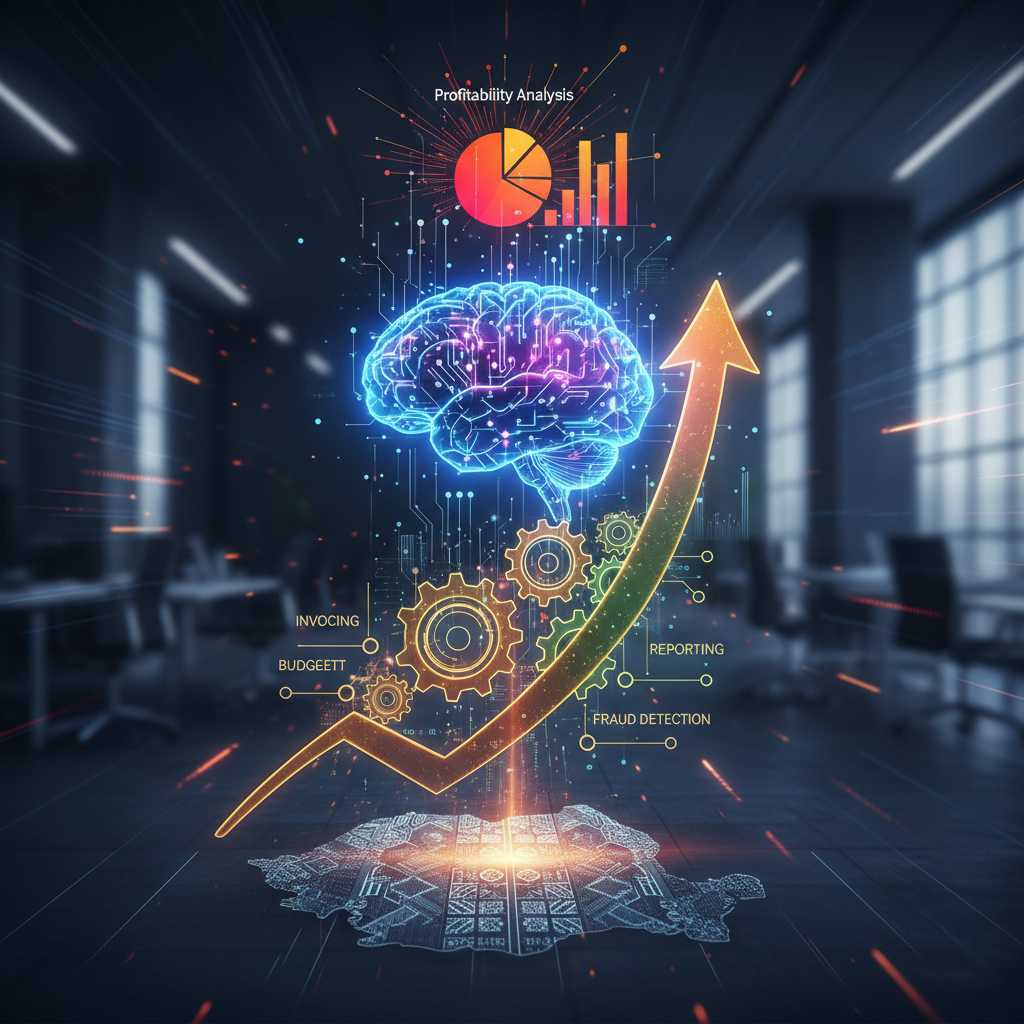
AI-Powered Profitability Analysis: Automating Financial Processes in Romanian Businesses
A revolution is underway in the financial departments of Romanian businesses. Artificial Intelligence (AI) is no longer a futuristic concept but a tangible tool that can redefine how companies manage their finances, offering unprecedented opportunities for increased efficiency and profitability. By automating repetitive and data-intensive tasks, AI frees up financial professionals to focus on strategic initiatives, providing deeper insights and fostering data-driven decision-making.
The AI Imperative in Romanian Finance
The Romanian business landscape, like many others globally, is increasingly competitive. To thrive, companies must not only optimize their operations but also proactively identify and capitalize on growth opportunities. This is where AI excels. By automating various financial processes, businesses can reduce operational costs, minimize human error, and gain real-time visibility into their financial health.
Key Financial Processes Ripe for AI Automation
The potential applications of AI in a finance department are vast. Here are some of the key areas where AI can deliver significant impact:
1. Data Protection and Management
At the core of any financial operation is data. The sheer volume and sensitivity of financial data necessitate robust data protection and management protocols. While the ING Romania source focuses on personal data protection for customers, the principles extend to internal financial data. AI can play a crucial role in:
- Automated Data Classification and Anonymization: AI algorithms can categorize sensitive financial data and automatically apply anonymization techniques where necessary, ensuring compliance with regulations like GDPR.
- Anomaly Detection in Data Access: AI can monitor access patterns to financial data and flag unusual activities, potentially indicating security breaches or internal fraud attempts.
- Streamlined Data Auditing: AI can automate the auditing of financial data, cross-referencing information across multiple systems to ensure consistency and accuracy, and reducing the manual effort involved in compliance checks.
2. Invoice Processing and Accounts Payable Automation
Manual invoice processing is a time-consuming and error-prone task. AI-powered solutions can revolutionize this process:
- Intelligent Document Processing (IDP): AI can extract relevant information from invoices (vendor name, invoice number, amount, due date) regardless of their format, eliminating manual data entry.
- Automated Matching and Reconciliation: AI can automatically match invoices with purchase orders and goods receipts, identifying discrepancies and flagging them for human review.
- Automated Payment Scheduling: Based on payment terms and cash flow forecasts, AI can optimize payment schedules, taking advantage of early payment discounts and avoiding late payment penalties.
3. Expense Management
Managing employee expenses can be a significant administrative burden. AI can streamline this process:
- Automated Receipt Scanning and Categorization: Employees can simply snap a picture of their receipts, and AI can extract the relevant data and categorize the expense automatically.
- Policy Compliance Checks: AI can automatically verify if expenses comply with company policies, flagging out-of-policy spending for review.
- Fraud Detection: AI can analyze expense patterns to identify anomalies that may indicate fraudulent claims.
4. Financial Reporting and Analysis
Generating accurate and timely financial reports is crucial for informed decision-making. AI can significantly enhance this area:
- Automated Report Generation: AI can compile data from various sources to generate customized financial reports (e.g., profit and loss statements, balance sheets, cash flow statements) with minimal human intervention.
- Predictive Analytics for Forecasting: AI can analyze historical financial data to forecast future trends, such as revenue, expenses, and cash flow, providing more accurate and dynamic financial planning.
- Identification of Key Performance Indicators (KPIs): AI can identify and track key financial KPIs, providing real-time insights into business performance and highlighting areas that require attention.
5. Credit Risk Assessment and Management
While not explicitly part of the provided sources, the reference to "financial, legal, and fiscal information about any company in Romania" from Termene.ro highlights the importance of comprehensive company data. AI can leverage such data for enhanced credit risk assessment:
- Automated Data Gathering and Analysis: AI can rapidly collect and analyze vast amounts of data from various sources (financial statements, credit bureaus, news articles, social media) to assess the creditworthiness of customers and partners.
- Predictive Models for Default Risk: AI can build sophisticated models to predict the likelihood of default, enabling businesses to make more informed lending and credit extension decisions.
- Real-time Risk Monitoring: AI can continuously monitor changes in a client's financial health or market conditions, alerting financial departments to emerging risks.
The Future is Automated
The integration of AI into financial departments is not merely about cost reduction; it's about strategic advantage. By embracing AI, Romanian businesses can create more agile, efficient, and insightful financial operations. This shift allows financial professionals to move beyond transactional tasks and become true strategic partners, driving business growth and ensuring long-term profitability in an increasingly complex and data-rich world. The trust in how data is handled, as emphasized by ING, will be paramount in this digital transformation, making AI-powered data governance solutions even more critical.
Sources
- ING Romania. "Protecția datelor personale." https://ing.ro/ing-in-romania/informatii-utile/protectie-date-personale
- Termene.ro. "Cristiana Deca, Decalex Digital: Încrederea consumatorului român..." https://termene.ro/articole/cristiana-deca-decalex-digital-increderea-consumatorului-roman-se-recastiga-greu-prima-runda
Frequently asked questions
How can AI enhance financial operations in Romanian businesses?
AI enhances financial operations in Romanian businesses by automating repetitive tasks, reducing errors, and providing real-time financial visibility. It enables professionals to focus on strategic initiatives, improving efficiency, data protection, and ultimately, profitability.
What financial processes can AI automate in Romania?
AI can automate several key financial processes in Romania, including data protection and management, invoice processing and accounts payable, expense management, and financial reporting and analysis. This streamlines operations and improves compliance.
Does AI help with data protection in finance for Romanian companies?
Yes, AI significantly aids data protection in finance for Romanian companies. It can automate data classification, apply anonymization techniques for GDPR compliance, monitor for unusual access patterns, and streamline data auditing to ensure accuracy and security.
How does AI improve financial reporting and analysis for businesses in Romania?
AI improves financial reporting and analysis by automating report generation, providing predictive analytics for accurate forecasting of trends like revenue and expenses, and identifying key performance indicators (KPIs). This supports informed, data-driven decision-making.
Can AI assist with credit risk assessment for Romanian businesses?
AI can enhance credit risk assessment for Romanian businesses by automatically gathering and analyzing vast amounts of data. It builds predictive models for default risk and offers real-time monitoring of client financial health, leading to more informed lending decisions.
What is the primary benefit of AI integration in Romanian financial departments?
The primary benefit of AI integration in Romanian financial departments is achieving strategic advantage. It creates more agile and efficient operations, transforms financial professionals into strategic partners, drives business growth, and ensures long-term profitability by leveraging data insights.