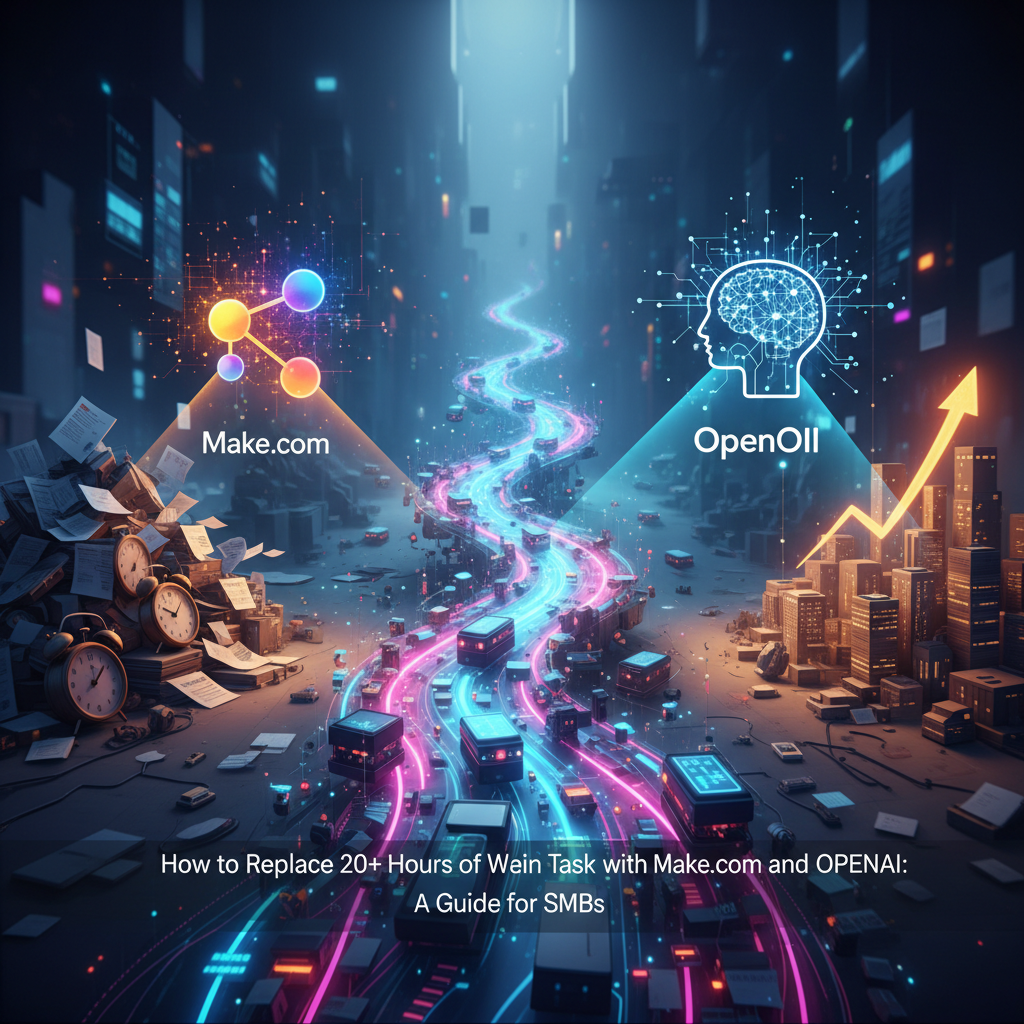
Reclaim Your Time: How SMBs Can Automate 20+ Hours of Admin with Make.com and OpenAI
Reclaim Your Time: How SMBs Can Automate 20+ Hours of Admin with Make.com and OpenAI
In today's fast-paced business environment, small and medium-sized businesses (SMBs) are constantly seeking ways to optimize operations, reduce costs, and empower their teams to focus on high-value tasks. One of the most pervasive, yet often overlooked, drains on productivity is the sheer volume of administrative work. Many companies still operate with outdated, manual processes, leading to significant time wastage and missed opportunities. However, with the advent of powerful automation platforms like Make.com and advanced AI models like OpenAI, SMBs now have an unprecedented opportunity to reclaim dozens of hours each week previously lost to repetitive admin.
This isn't about minor tweaks; it's about transforming your operational efficiency. Imagine freeing up 20, 30, or even 40 hours a week – per department – from mundane tasks. That's the equivalent of a full-time employee dedicated to driving innovation and growth, without the added payroll. The reality for many businesses is that 73% of IT leaders report automation delivering 10-50% time savings across daily tasks, yet a significant number are still lagging.
The Silent Productivity Killer: Manual Admin Tasks
Take a moment to consider the "old way" of doing things that still plagues many SMBs:
- Finance teams might spend tens of hours monthly manually entering invoice data, a task ripe for automation.
- HR departments often dedicate 8 hours or more weekly to handling repetitive requests like leave applications or updating employee records.
- Marketing teams frequently find themselves copying leads from various forms into their CRM systems, a process that can take entire afternoons.
These seemingly small, individual tasks accumulate rapidly, creating a massive drain on resources. This manual data movement and repetitive administrative work prevent teams from focusing on their core competencies, hindering strategic thinking and client engagement.
The AI-First Approach: A New Era of Efficiency
The "new way" leverages intelligent automation to drastically reduce, or even eliminate, the need for human intervention in these repetitive tasks. Here's what an AI-first approach looks like:
- Automated invoice processing: Invoices trigger workflows instantly upon arrival, with AI extracting relevant data and routing it for approval without human touch.
- Streamlined HR onboarding: Automated systems collect documents, provision accounts, and schedule training, accelerating the onboarding process by as much as 67%.
- Instant lead management: Leads captured from various sources are automatically fed into CRM systems, triggering personalized nurture sequences in seconds, not days.
The financial impact of this shift is substantial. Businesses that implement workflow automation report an average saving of 257 hours monthly, translating into approximately $155,000 in annual labor cost savings. These figures are not just theoretical; they represent concrete, measurable improvements in operational efficiency and profitability.
The 4-Phase Automation Stack: A Blueprint for Success
Successfully implementing workflow automation, especially for SMBs, requires a structured approach. Here's a proven 4-phase framework:
Phase 1: Audit and Identify (Week 1)
The first step is to thoroughly examine your existing processes. Map out every repetitive task performed more than three times a week. Focus on tasks that are high-volume but low in complexity. These are the "low-hanging fruit" that will provide the quickest and most impactful returns on your automation efforts. Common areas include financial data entry, routine HR requests, and lead generation follow-ups.
Phase 2: Connect Your Ecosystem (Week 2)
Once you've identified your target tasks, the next phase involves connecting the various applications and tools you use. This is where platforms like Make.com shine. Make.com acts as the central nervous system, integrating disparate systems such as your CRM, accounting software, communication tools, and AI services like OpenAI.
Make.com stands out against alternatives like Zapier due to its robust capabilities for complex workflows and significantly more operations per dollar. This makes it an ideal choice for SMBs looking to maximize their automation budget without sacrificing power or flexibility. The philosophy here is to integrate best-in-class individual tools rather than relying on bloated all-in-one platforms that often compromise on specific functionalities.
Phase 3: Build Smart Triggers and Actions (Week 3)
With your systems connected, you can now build the "brains" of your automation. This involves setting up specific triggers and actions. A trigger is an event that initiates a workflow (e.g., a new email in an inbox, a form submission, a new entry in a spreadsheet). Once triggered, Make.com orchestrates a series of actions across your connected applications.
This is where OpenAI comes into play. For tasks requiring intelligent processing – such as summarizing customer feedback, generating personalized email responses, categorizing incoming data, or even drafting initial marketing copy – OpenAI can be seamlessly integrated into your Make.com workflows. For instance, an incoming customer service email could trigger an OpenAI model to analyze its sentiment, extract key information, and then create a draft response, all before a human agent even sees it.
Phase 4: Monitor and Optimize (Ongoing)
Automation is not a set-it-and-forget-it endeavor. It requires continuous monitoring and optimization. Regularly review the performance of your automated workflows. Are they operating efficiently? Are there any bottlenecks? Are there new opportunities for further automation? This iterative process ensures that your systems remain agile and continue to deliver maximum value as your business evolves.
The Payoff: More Than Just Time Savings
By strategically implementing workflow automation with tools like Make.com and OpenAI, SMBs can achieve far more than just saving 20+ hours of weekly admin tasks. They can foster a culture of efficiency, empower employees to engage in more creative and strategic work, reduce human error, and ultimately, drive significant business growth and profitability.
The journey to an automated future begins with a single step: identifying where your precious hours are currently being spent. The tools are available; the blueprint is clear. It's time for SMBs to embrace the power of AI-driven automation and unlock their full potential.
Sources
- Rajat AI: Workflow Automation: Save 40 Hours a Week - Rajat AI (https://rajatgautam.com/blog/workflow-automation-101/)
Frequently asked questions
How can SMBs automate admin tasks?
SMBs can automate administrative tasks by leveraging platforms like Make.com to integrate various applications and then incorporating AI services such as OpenAI for intelligent processing. This combination allows for streamlining repetitive processes in areas like finance, HR, and marketing.
Which tools are recommended for SMB automation?
Make.com is recommended for connecting diverse applications and orchestrating workflows. OpenAI is suggested for tasks requiring intelligent processing, like summarizing data, generating responses, or categorizing information, making them ideal for an AI-first automation approach.
What kind of admin tasks can be automated?
Common administrative tasks ripe for automation include manual invoice data entry, repetitive HR requests like leave applications, and copying leads from forms into CRM systems. These high-volume, low-complexity tasks yield significant time savings.
What is the 4-phase automation framework for SMBs?
The framework involves Phase 1: Audit and Identify repetitive tasks; Phase 2: Connect your ecosystem using tools like Make.com; Phase 3: Build smart triggers and actions, often with OpenAI; and Phase 4: Monitor and Optimize workflows continuously for maximum value.
What are the benefits of automating admin for SMBs?
Automating admin tasks helps SMBs save over 20 hours weekly, reduces operational costs, minimizes human error, and empowers employees to focus on strategic, high-value work. This ultimately leads to increased business efficiency, profitability, and growth.